Tuesday, September 20, 2011

Franklin Roosevelt and the Holocaust

In "The Conquerors" by Michael Beschloss, the author struggles to find explanations for some of Roosevelt's behaviors. For example, Roosevelt's silence about the holocaust during the war. " Franklin Roosevelt began receiving information as early as 1942 that Adolf Hitler, under a veil of secrecy, was carrying out his threats to" annihilate the Jewish race." One might expect the President to have gone on the radio and told Americans in stirring language exactly what his government was learning about the Nazi death camps, adding that this unimaginable crime was exactly what the Allies were fighting to banish from the world.

But Roosevelt made no such speech. Nor did he command the American propaganda organs to publicize everything the government knew about the extermination of the Jews. Instead, through at least the early months of 1944, the President's references to the subject were vague and seldom."

" In July 1942, the president of the American Jewish Congress, Rabbi Stephen Wise, asked the President for a statement that could be read to a Madison Square Garden rally against Hitler's oppression of Jews. -- But the president did not mention extermination or Jewish victims. Instead his statement said that Americans "sympathize with all victims of Nazi crime' and would hold the perpetrators "to strict accountability in a day of reckoning which will surely come."

In December 1942, Wise asked Roosevelt to tell the world about Hitler's war against the Jews and to try to stop it. The President replied that while his government knew many of the facts, it was hard to know what to do. Pressed for a statement, he advised Wise and the Jewish leaders to reissue the Madison Square Garden statement that he had issued in July. He insisted that that statement be quoted precisely.

In July 1943, at the White House, Lieutenant Jan Karski of the Polish underground army told Roosevelt about the mass murder of Jews that he had seen take place in a Polish concentration camp:"Our underground authorities are absolutely sure that the Germans are out to exterminate the entire Jewish population of Europe." The President listened intently but when Karski implored Roosevelt to intervene, the President replied, "Tell your nation that we shall win the war."

"As the historian Richard Breitman has written, Roosevelt's government "did not match Adolf Hitler's single-minded frenzy to wipe out the Jewish race with corresponding determination to save those Jews who could be saved."

"As Hitler's war against European Jewry raged on, Franklin Roosevelt maintained his silence. Before 1944, he avoided discussing the matter."

" By early June 1944, the Nazis had deported over 1/3 of Hungary's Jews in only three weeks, Jacob Rosenhein and other Jewish leaders wrote to American and British officials, imploring them to bomb the railway lines from Hungary to the death camp at Auschwitz in Poland." This was not done. Initially, Undersecretary McCloy's view was that diverting bombers and crews from bombing German industry and other strategic targets might have postponed VE day." Thanks to new information, however, we may conclude that the man who ultimately refused to bomb Auschwitz may not have been John McCloy but Franklin Roosevelt." Liddel Hart in his book "Strategy" stated that the war would probably have ended much sooner had the bombing targets not been shifted from millitary and industrial ones to civillian ones. We must ask ourselves why the bombing emphasis was shifted to civillian targets and why Roosevelt refused to bomb the concentration camps and the rail lines leading to them? To answer those questions, we must ask what the actual, not the stated war aims of the Allies were? The actual war aims of the Americans were stated succinctly by Eisenhower as he was about to cross the German border when he stated that his intent was to "kill as many Germans as he could." Michael Beschloss is too dimwitted and too infatuated with Roosevelt to look into actual American war aims.

During the war, most of the German men were in the armed forces and were not in danger of the American bombing of civilian neighborhoods. The primary inhabitants were women and children and these were the obvious targets because they were the future of Germany and Germany was to have no future. All the other Allies had become American client states who became dependent on Lend Lease. Even the Soviets had become a client state of the Americans because they still continued receiving Lend Lease aid into 1948, well after the beginning of the Cold War (as per James Bacque in Crimes and Mercies). Yes I know that Lend Lease formally ended in 1946 but commitments made under Lend Lease before it's formal termination were still made as late as 1948. The Soviets were the prime agents in the ethnic cleansing of eastern Europe's German population in which 18 million men, women and children were thrown out of their homes without food and shelter. Millions were murdered in the process, often with bestial cruelty that far exceeded the Nazis at their worst. As long as the Soviets continued this "good work", they were rewarded with Lend Lease. When Churchill balked at some of the American's demands, he was threatened with withdrawal of Lend Lease aid.

Now as to the reason that the Allies refused to bomb the concentration camps and the rail lines leading to them, I suspect that it was the result of a private agreement between Roosevelt and Stalin where Stalin asked Roosevelt not to interfere with the concentration camps because the removal of it's Jews would make Poland far more manageable after the war. Neither Roosevelt nor Stalin had any love for Jews. During the war, the safest place to be was probably along the railway lines leading to the concentration camps. Roosevelt was just another mass murderer alongside Hitler and Stalin. It is to Roosevelt and to the American Oligarchs whom he represented, that we can attribute responsibility for the murder of 12 to 14 million ethnic Germans during the period of 1945 through 1950. This figure is also from James Bacque's Crimes and Mercies. Bacque estimates that if the plans to fully implement the Morgenthau Plan had not been reversed, the death total among ethnic Germans after the war would have gone as high as 40 million. I would probably have been one of them. This mass murder of ethnic Germans is also part of the Holocaust but no one ever speaks about it.

Beschloss documents Roosevelt's hatred of anything German quite well. Roosevelt shrieked about how Germans were a race of militaristic beasts who had three times plunged the world into war. For the first time, he must have referred to the Franco-Prussian war. The French in that case had attacked Germany. The second time would have been WWI. I read with interest on the Web that the group of Serb assassins and their handlers (who assassinated Franz Ferdinand and his wife) met in Toulouse a month or so before the assassination. Why would they meet in Toulouse? I suspect that they were there to receive assurances of support from high level French and Russian officials that these countries would go to war if Austria-Hungary contested the outrage militarily. And that is precisely what happened. Primary responsibility for starting WWI lies with the French. And WWII? Britain had signed a treaty with Poland. However, there was an unpublished codicil to that treaty that Britain would go to war only if Poland was attacked by Germany, not by any other country. Thus, the fact that Poland was simultaneously attacked by the Soviet Union had no effect in triggering Britain's treaty obligations. Poland was there obviously only there  to draw Germany into war.

Beschloss mentions that Roosevelt entered into diplomatic relations with the Soviet Union in 1934 seeking allies against Germany. This seemed entirely natural to him. I guess he argued with himself that didn't the Nazis inaugurate the Holocaust? This would be true. However, the Nazis of 1934 were not the Nazis of 1942. In 1934 they were no worse than the vicious nationalists who governed Poland and Czechoslovakia who would come in their pants at the thought of driving out their German and Jewish minorities.The true monster mass murderers of 1934 were the Soviet communists. I suggest that there would have been no Holocaust had the Allies not rejected any offer at negotiating peace with Germany. It would be interesting to be able to read the notes of the Wannsee conference at which the Final Solution was decided on. I suspect that the idiot Nazis concluded that yet again the Jews were responsible for a war that they could increasingly see they could not win. After all, weren't there many Jews in Capitalist America and in Communist Russia?

Germany did send out Rudolph Hess to negotiate an end to hostilities with Britain. A very generous offer was made to Britain. Germany would pull out of France, the Low Countries and Denmark and Norway in return for a free hand against the Soviet Union. A very generous offer and one that I would think tempted Churchill severely. I suspect though that he may have received threats from Roosevelt that the US would take Canada and other British possessions into "protective custody" if he made peace with Germany. A fateful decision because Britain lost it's empire anyway as a result of a refusal to make peace. Britain was so weakened by the war that the empire slipped away.

Roosevelt met Stalin for the first time at the Tehran conference. Roosevelt was reportedly as jubilant as a schoolboy at meeting "Uncle Joe". Tehran was occupied by the Soviet Union and the compound in which they met was 100% under the control of the NKVD. The NKVD were the supreme poisoners of their day. On the first day there, Roosevelt became severely ill. His staff at first thought that he had been poisoned. Then they concluded that he had gotten a case of Grippe. However, he got steadily worse and a few months later, died. It seems highly probable to me that he was poisoned by Stalin. I think that the World owes Stalin a vote of thanks for getting rid of a fellow mass murderer

Wednesday, December 29, 2010

The Chief Culprit by Viktor Suvorov

Chief Culprit: Stalin's Grand Design to start World War II by Viktor Suvorov. Suvorov's book is based on extensive research into the Soviet archives.
Both Lenin and Stalin believed that another world war was necessary in order to achieve the triumph of communism. A war even bloodier than the previous one. Germany was to play the key role. He needed to build Germany up and involve it in a bloody war with England and France and he needed a common border with Germany so that his forces could easily roll in when Germany was distracted. His agent of choice was Hitler's NSDAP party because the other parties were opposed to war. The NSDAP though was slipping in popularity. In the emergency Reichstag election of November 6, 1932, the NSDAP received only 11,705,000 votes, 2 million less than in the previous election. The Social Democrats received 7,231,000 votes and the Communist Party, 5,971,000 votes. If the Communists had joined the Social Democrats, the Nazis would now be a quaint but unpleasant memory. Instead, Stalin ordered the German Communist Party to oppose the Social Democrats. This allowed Hitler to forge alliances with splinter parties and obtain a majority. Stalin built Germany up through delivery of essential supplies such as oil, cotton, grain, magnesium, chrome, copper,tin,nickel, vanadium, wolfram and molybdenum. Suvorov states that without these supplies, Hitler would have been unable to conquer Europe.

Germany and the USSR were to attack Poland simultaneously but Stalin delayed his attack for two weeks so that the onus of starting the war would fall on Germany. While Hitler was mopping up France, Stalin took over the Baltic republics and took Bessarabia from Rumania. This placed him within 100 kilometers of the Ploesti oilfield. Huge armies were placed in Bessarabia, ready to seize the oilfields. Hitlers intelligence revealed that huge Soviet armies were assembling at the border. Hitler decided to forego the planned assault on Britain because the Soviets were by far the greater threat. He quietly began marshalling forces on his eastern border. Soviet intelligence did not see any evidence of a planned German assault because supplies necessary to fight a Winter war were not being amassed by Germany. Things like sheepskin coats and low temperature lubricants.

Operation Barbarossa took place two weeks before the planned Soviet assault on Germany. The Soviets had massed 174 divisions right at the border. Trouble was that they were equipped with offensive weapons only, not defensive ones. For example, all the planes were bombers, no fighter planes to protect the bombers. The plan was for the bombers to destroy the Luftwaffe on the ground and there would then be no need for fighter planes. The reverse happened. The Luftwaffe destroyed the Soviet planes and then destroyed thousands of Soviet tanks. These 174 divisions were obliterated but they formed only the First Echelon of Soviet armies. Further on in, German forces encountered the Second Echelon of armies, an even larger force. Fortunately, many of the Second Echelon's heavy weapons were still in transit. German intelligence was not even aware of the existence of the Second Echelon forces. Many of these were also destroyed but German hopes of reaching Moscow before the Winter were beginning to fade. The Soviets had limitless manpower and weapons. They had 10 times the number of tanks, planes and heavy artillery than the German forces. Suvorov points out though that even if German forces had reached Moscow, this would still not have ended the war because of the vast industries in the Urals, hundreds of miles further east. For manpower, the Soviets began sending out millions of Gulag prisoners to fight. There were not enough Red Army uniforms, so they fought in their black Gulag uniforms. Behind them were NKVD troops, ready to shoot anyone who refused to fight or contemplated surrender. The Gulag soldiers were treated as expendable cannon fodder. When the British offered the Soviets mine detectors, the offer was declined. The Soviet general explained that they used human beings for that purpose. They would make thousands of Gulag soldiers run across the mine fields, detonating the mines with their bodies.

Saturday, October 2, 2010

The Origins of the New Germany

At the time that I was born, we lived in Espelkamp, a remote farming village (at the time) in Westphalia, Germany. Shortly after my birth, we moved to the even more remote farming village of Wehe, In both places, the daily language was not German but rather Plattdeutsch (Low Saxon). Plattdeutsch was thus my native language. Starting around 1952 though, many of the farmers sold their lands and vast housing projects were built to house thousands of expellees from the east, mostly from Silesia. These highly skilled and educated people revolutionized the area and it became increasingly industrial. These people spoke only German and showed no interest in learning the local language, Plattdeutsch. Some of the locals regarded them as being Polish, rather than Germans. There is probably some truth in that since the Silesians were a mixed border population. Whatever the truth may be, the Silesians were thrown out of their homes for the simple sin of being Germans. They were the victims of Ethnic Cleansing. This was a policy of the victorious Allies, who had won the war. Roads were paved and industries built and the local ways of life that had endured with little change over the past 1000 years were altered completely. I have wondered for a long time what it was that precipitated these major changes. What was the cause of WW1 and WW2? I think the causes can be traced back to the mid 19th century.

During and after the American civil war, vast agricultural lands were opened to settlement, largely due to improved steel plows that allowed farmers to plow lands covered by tough prairie grasses. America then become a huge exporter of cheap grains. The same thing happened in Russia. Rapidly industrializing Germany became a major customer for these grains. Everyone would seem to have benefited from this process except for the German Junker class, whose wealth was based on their vast agricultural estates in eastern Germany. They could not compete economically with these cheap imports. Since they could not compete with cheap grain imports, and since they controlled the German government, they arranged for agricultural subsidies. They were not happy with the results though, especially when they became aware of the vast fortunes being made by their close cousins (literally) in England from the oil industry in the Persian Gulf. They wanted to get a share of this new wealth but were shut out by the English, Americans, French, Dutch and Italians who had gotten there first ( you will notice that these nations formed most of the Entente who opposed Germany in WW1).

Under the control of the Junkers, the German government then developed a close relationship with the Ottoman Turkish government. The persian gulf lands that were the object of everyone's attention were technically a part of the Ottoman Empire. The Ottoman Empire (then referred to as the Sick Man of Europe) was ignored, as the powerful oil companies moved in. The English got there first, having secured a concession to drill for oil in lands bordering the Persian Gulf. The Americans were next, having secured a concession to drill for oil in the interior. To the horror of the English, most of the oil proved to be in the interior. According to the Aramco Handbook, the Seven Sisters (as the major oil companies of the time were referred to) threatened to drag their host countries into war. There was no oil company present that was rooted in Germany. War was averted, according to the Aramco Handbook, by an Armenian with Turkish citizenship who offered to broker a settlement that would be to everyone's satisfaction in return for a 5% stake. This was accepted by the Seven Sisters and he became known as Mr. 5%. This took place around 1905. This threatened war was not against Germany but rather among the "Democracies", even though we are assured that democracies are always just and un-warlike.

Having been excluded from a share of the Persian Gulf pie, the Junkers took the tack of trying to build up the Ottoman Empire. At considerable cost to German taxpayers ( who were not planned to be beneficiaries), the German government announced plans to build the Berlin to Baghdad railway. This caused considerable concern to the "Democracies" but this concern became frantic when the German government subsequently announced it's intention to extend the railway all the way to the Persian Gulf. Suddenly Kuwait declared it's independence from the Ottoman Empire, blocking access to the Gulf and a British fleet steamed into the Gulf, threatening war against anyone who did not recognize Kuwait's independence. This fleet was paid for by British taxpayers, who were likewise not intended to be the beneficiaries of the money to be made from Middle Eastern oil.

Let me make an aside here. It is my contention that wars are not initiated by humane grey haired sages who hold that war is a terrible thing but that it will confer the greatest good to the greatest many. Wars are initiated by powerful cabals who have seized control of their countries and utilize the lives and taxes of fellow citizens to further their ends (money and power). The ordinary citizen is not expected to benefit from these enterprises. They are just expected to pay for them and to die for them. The cabal that has controlled the United states for over a century consists of the families that control the oil industry. As rationales for going to war, the citizens are fed simple slogans, soundbites as it were, that have nothing to do with the actual reasons for going to war. Incidents are manufactured like the Gulf of Tonkin Incident, the Zimmerman Telegraph, Weapons of Mass Destruction, the sinking of the battleship Maine. In his book. "Strategy", Liddell Hart describes how Roosevelt manipulated Japan into attacking Pearl Harbor. To Roosevelt, Japan was a minor irritant. The real reason was to provide a pretext for entering the war against Germany. Once war was declared, 9/10 of American resources were devoted to making war against Germany. We have seen a similar tactic recently. We were attacked by Afganistan but 9/10 of our millitary resources were spent on a war against Iraq. Sometimes a tempting target is offered. The rationale for the first Iraq war was the invasion of Kuwait by Iraq. However, Saddam Hussein made no move against Kuwait until he was reassured by ambassador Glasspie that Kuwait did not represent a strategic interest to the United States.

Otto von Bismarck once remarked that nation states do not possess morals and ethics, just interests. I think that he was right. None of the leaders of the participants in WW1 and WW2 engaged in war as a moral crusade. Yes, the Nazis would make a dog want to vomit. But the Soviets were no better. All of the participants engaged in mass murder of civilian populations, both during and after the war.

WW1 started with the assassination of Archduke Franz Ferdinand and his wife, Sofie Chotek by a Serb semi-governmental institution. If national governments possessed morals and ethics then they would all have ganged up on Serbia and kicked the crap out of them. Instead, when Austria-Hungary attacked Serbia, Russia, Britain and France declared war against Austria-Hungary. Germany, allied to Austria-Hungary, then declared war against the Entente. A question has arisen in my mind. How did a little banana republic like Serbia think that it could get away with this assassination. It is my suspicion that they were put up to do it by the Entente, that they were promised Bosnia, Croatia and Slovenia with a successful conclusion of the war. And I don't think that the dismemberment of Austria-Hungary was the ultimate goal. The ultimate goal was to draw Germany into war. German power, with the expansion of it's industry, had been growing by leaps and bounds, as had it's involvement with the Ottoman Empire, training Ottoman soldiers, supplying weapons, etc. It was time to cut Germany down to size.

With the successful conclusion of WW1, Austria-Hungary was dismembered and it's territory was parcelled out to pathologically nationalist successor states. Millions of Germans and Hungarians suddenly found themselves as unwanted and despised minorities in these new states. The Suedetenland (the German portion of Bohemia and Moravia) was one of the most industrialized regions of the world. Formerly they produced consumer goods for a market of 53 million people (the population of the Austro-Hungarian empire. Now their market was restricted to the 13 million people in the new Czechslovak state. The Suedeten Germans pleaded with Eduard Benes to negotiate trade treaties with Austria, Hungary and the other successor states so that their goods would not be excluded from these markets. Benes was not interested. Germans were not permitted to bid on state contracts. 1,700,000 Hektars of land in the German and Hungarian areas were seized for redistribution with very little compensation. Most of these lands were turned over to Czech colonists who were established in colonies in what had been 100% German and Hungarian territories. In response to criticism, Benes announced plans to divide the state into cantons, like Switzerland, but nothing ever came of this. Germans were very much treated as second class citizens. In desperation, the actions of Benes drove Konrad Henlein, the leader of the Suedeten Germans, into the arms of Hitler.

Ethnic cleansing was very much in the mind of the Polish leadership. Of 3 million Germans who found themselves on the wrong side of the border when the Polish Corridor was created, one million were thrown out of their homes in the period between the wars. According to Carl Tighe in his book, Danzig, the Polish secret service provided financial support to the Irgun. It is not that they liked Jews. They hated them. It was their hope that the Irgun would throw the British out of Palestine. If that happened, the Polish leadership planned to throw all 3.5 million Jews out of the country.

The rationale advanced for the ethnic cleansing of Eastern Europe's German population was that Germans minorities formed an indigestible population and were a source of problems for the host states. There may be some truth in that but you can hardly expect a different outcome when you treat a minority population so poorly.

Next, I will describe in some detail how the Ethnic cleansing was achieved. A good source of information is Alfred Maurice de Zayas' A Terrible Revenge

Tuesday, October 20, 2009

The Plumbers Menorah and Other Tales of NY

After cracking about two dozen Black Walnuts, the very substantial nutcracker that I had bought in Woodstock, broke under the strain. The steel pin linking both halves simply bent under the strain. I went to my local hardware store in Innwood. The proprietor offered me a flimsy nutcracker. When I told him that Black Walnuts would laugh at such a flimsy nutcracker, he began muttering to himself in Yiddish. When I asked for a visegrip, he looked at me like I had lost my mind. He offered me a tiny visegrip that was too small to accomplish anything.

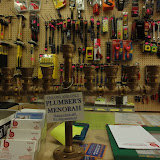
Today, I decided to stop off at a hardware store near Zabars on Broadway. They had been there forever but had just gone out of business. Another victim of Depression II. I soothed my hurts with a candied chestnut Gelato and the owner told me about another hardware store on Amsterdam Ave, a few blocks away. This was Beacon Paint & Hardware at 371 Amsterdam Ave, www.beaconpaint,com. The first thing you notice upon entering is a huge Menorah made of plumbing parts. They will happily sell you this Menorah for $109.99 and they will ship it anywhere (although probably at a very substantial cost). Anyway, I got a monster visegrip that makes mincemeat of the Black Walnuts. I am now looking for tougher nuts to crack.

Sunday, October 18, 2009

FISTFA Oct 17 2009

Made beef, barley and mushroom stew again. I was going to bake two Black Walnut pies from the nuts I had packed in the Catskills a few days before. However, the nuts were so tough that they broke my nutcracker. Imagine trying to crack open large pebbles. Made more Sumac-ade from the Sumac pods I picked in the Catskills. The Moslows brought over a huge amount of food, as did the Phillipses. No one starves here. Rather the opposite. Bob Rodriguez enjoyed watching (if that is the term for a blind man) one of my old serials, G-men versus the Phantom Legion. Mike Moslow and I exchanged electronic files. I gave him two old Long John Nebel shows. One featured Ray Palmer as guest and they discussed the Shaver Mystery and the other featured a Mr. van Tassel talking about his trips in flying saucers. Mike let me copy some CD's with hundreds of Jean Shepherd shows. The next FISTFA will take place on Nov 14th as there would have been a conflict with Philcon the following weekend. Today's FISTFA was the 5th anniversary of the current revival of FISTFA.

Saturday, October 17, 2009

Chennai Garden and Kalustyan

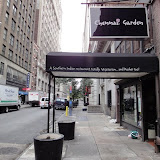
Chennai Garden, 129 E 27th Street (bet. Park and Lex), 212-689-1000, www.chennaigarden.com, sets out a buffet brunch for $6.95 of wonderful South Indian vegetarian (and Kosher) dishes. Of course being vegetarian makes it easy for them to achieve Kosher certification but the fact is that they have taken the trouble to obtain such certification. I fasted that morning and I piled three plates high and wound up so stuffed that I could not eat any more. I don't think that my meal cost me more than it would have cost me in some fast food feedlot. Out of towners may dote on their cheeseburgers and deep fried Oreo cookies but they can keep that crap to themselves.

After lunch we explored the neighboring Kalustyan's, 123 Lexington Ave, NY,NY 10016, tel 212-685-3451, www.kalustyans.com. Never have I seen such a profusion of herbs and spices as well as specialty Middle Eastern foods. I bought a bag of Gum Arabic for $1.99. Among the peppercorns I found bags of peppers that looked like miniature pine cones. Never even heard of such things. They even sell Sumac berries, so that I don't have to go into the wilderness to pick them any more

Thursday, October 15, 2009

Shopping Lower East Side Oct 13 2009

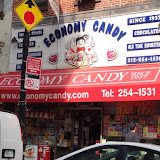
There are many fine retail food merchants in New York, such as Zabars and Fairway. There you can get first quality foods from the world over. However, on the Lower East Side, there are many food producers who are a step away from the retail merchants. For example, Kossars Bialys, Guss' Pickles, Streits, Yonah Schimmels Knishes. Their products are fresher and they offer a greater variety. Zabars sells Kossars Bialys but they are bagged and are days old by the time you get them. In my experience, the bialys are covered with a fungal beard within 2 days of purchase. Others are not producers but are specialists such as Russ and Daughters whose selection of smoked and pickled fish stagger the imagination. Economy Candy sells candies that you thought had been out of production for decades, such as Sen Sen, Mary Janes, Beemans Pepsin Gun, Teaberry Gum. In addition, they will cut you a chunk of Halvah off a block. Do you want Halvah with or without chocolate, pistachios? Dried blueberries, cherries, strawberries, mangos, cantalupe, candied orange peel. All significantly cheaper than you can get them elsewhere.

A lot of these products are just unavailable outside of NYC. Yes you can get pickled Vita Herrings in a jar outside of NY but how about Matjes Herring, Bismark herring, lox cut paper thin in front of your eyes? And do you want your lox to come from Swedish salmon, Norwegian, Scottish, Irish, Nova Scotia, Alaska? All of these and many more are available at Russ and Daughters. Where else can you get ready made herring and beet salad?

Yonah Schimmels will sell you a jar of yogurt that comes from a Bulgarian yogurt culture that they have maintained since about 1890. The jar is a glass jar with a screw top that they have recycled from elsewhere.

Wednesday, October 14, 2009

To Woodstock, Phoenicia and Woodland Valley, Catskills

In the mid 1950's, when my father got his first car, a used 1951 Nash, we drove up to Woodland Valley in the Catskills to go camping. We had no tent of other camping equipment but the Nash had this nice feature where you could move the front seat forward and fold the seatrest down to create a continuous sleeping platform in the whole car. In subsequent visits, we would reserve the lean-to to sleep in. Then we would hike the mountain trails, like the one to Slide Mountain. I had not been to the area since the early 1960's but since I am on vacation this week, I decided to rent a car and drive up there and take some pictures. Woodstock I had never been to but it has been so much in the news as a result of the concert that did not take place there in 1969, that I decided to see the place and to take pictures there as well. Unfortunately, the Woodland Valley campsite was closed for the season and they would not permit me to wander around and take pictures.

Monday, October 12, 2009

Muddy Cup Cafe & Environs Staten Island

And so I bid farewell to Manhattan to embark upon a sea voyage to that remote and misty isle of Staten Island in an effort to determine if there is any civilized life there. As a matter of fact, the Cup Cafe (formerly the Muddy Cup Cafe) is well worth the trip. On the same block is an antique shop, an art gallery, an auction house and an interesting restaurant, Vida. Around the corner is Hoppin John's Southern Cuisine & Catering and, if you must, a few blocks away on Bay Street is a White Castle. The cafe can be reached via the S78 bus from the St George ferry terminal. Get off the bus at the intersection of Beach and Van Duzer St, about a mile from the terminal. The auction house is Ira's Curiosity Place, tel 718-815-0376. Vida's phone no is 718-720-1501. The Exchange Gallery's phone no is 718-717-2253. Hoppin John's phone no is 718-727-2244. The Cup Cafe's number is 718-818-8100

Greenpoint Revisited June 2007

There are bakeries and butcher shops galore. I did not see a single supermarket, which is just as well.

The poppy strudel that I bought at Rzeszowska Bakery (948 Manhattan Ave) was sensational. Next time though, I will try the cheese babka.

There seemed to be a butcher on every block. Sometimes 2 or 3. I bought my meat at Quality Meat Market, 172 Bedford Ave, Brooklyn, NY 11211 Czeslava Dusza, owner. Tel 718-388-3437. All the butchers though seem to be closed on Sundays.

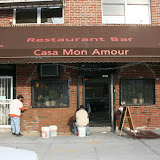
Casa Mon Amour looked interesting. I had never heard of a fusion Dominican/French cuisine before but I also came across a Colombian/French restaurant. Casa is located at 162 Franklin St, tel 718-349-1529. Beatrice Claray Wetcher is the owner. Open Monday to Saturday. Lunch special, all from steam (presumably this means a steam table) small:$5.00, large: $6.00

An interesting pub with 15 ales on tap was Pencil Factory. It was quiet with very broad floorboards. Ladies, the mens room was impeccably clean. I assume that the ladies room is even cleaner.

The place I definitely want to eat in is S&B Restaurant and Deli, Delicious Polish-American food, 194 Bedford Ave, 718-963-1536. Lunch special for $7.50, featuring soup of the day, 2 vegetables and a choice of blintzes, pierogis, potato dumplings, stuffed cabbage, bigos, etc.

The junk shop is The Vortex, 1084 Manhattan Ave, open 11 A.M to 7 P.M., 7 days a week. The owners wife has a similar shop 2 blocks down. Plus, there is a Salvation Army Thrift Store a block down.

There is a sushi restaurant, Katsu, with the menu in Polish. Japonska Kuchnia Domowa i Sushi. 1013 Manhattan Ave. Tel 718-389-2300.

Wild Ginger pan-asian vegan cafe, 212 Bedford Ave, Brooklyn, NY 11211. Tel 718-218-8828

Yet another Indian restaurant, Mamtaj Mahal, 135B North 5th St, Brooklyn, NY 11211. It seems reasonably priced. No Barfi on the desert menu though. Rats. Tel 718-599-1100.

Greenpoint revisited June 2007

Sunday, October 11, 2009

Openhouse New York Oct 2009

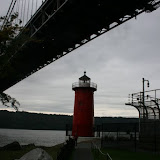
My thanks to my ex Barb in London for alerting me to this event. Without her notices, I would not know about half of the interesting things that go on in the city. This is the 7th year of Openhouse. On this occasion, many public and private facilities open their doors and even provide tours. The weekend did not start auspiciously. All the subway lines except for the M train were experiencing delays due to scheduled repairs. And it rained yesterday. On top of that, no one showed up to conduct a tour of The Little Red Lighthouse. Both my camera and my cellphone glistened with water. I decided to head back home and let my equipment dry out. I resumed my visits today but some of the places I really wanted to see were only open Saturday. Maybe I will have better luck next year

Wednesday, October 7, 2009

NY, NY June 2007

What is it that turns me off Hindu art? It strikes me as loud, garish, overstated. Like a woman putting on a vividly colored lipstick but doing it carelessly, smearing it beyond her lips. Or dousing herself with cheap dime store perfume so that she reeks and you can scarcely breather in her presence. The singing is even worse. The lyrics consist of Hare Krishna, sung over and over sung in a bellyaching, moaning style. The lyricist and singers should all be fired. Make that shot, Then pictures of the only Hungarian butcher left in NYC. It was formerly called Magyar Hentes but is now called Yorkville Meat Emporium and they are at the corner of 81 St and 2nd Ave. I was thinking of doing a series "butchers to know and Love" This one would definitely be included.

Gertels Bakery RIP June 2007

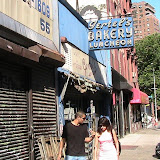
Gertels Bakery,a long standing tradition on the Lower East Side closed it's doors forever last Friday.It is due to be bulldozed to make way for, you guessed it, high rise luxury condominiums. One by one all the places that made New York special are being sucked out like marrow out of marrow bones. I used to shop there when I went next door to Kaddouri&Sons to buy the biggest and tastiest dried figs and dates in the known universe. The Kaddouri location is also scheduled to be flattened for the same reason as Gertels. Will this process only end when New York becomes as bland as the rest of the USA?

Tuesday, October 6, 2009

Mermaid Parade June 2007

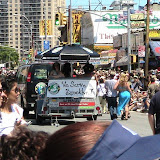
Will this be the last mermaid parade after Thor Equities has flattened half of Coney Island to build luxury high rises? Or will they sponsor future parades consisting of BMW's and SUV's. Is New York fated to become indistinguishable from Duluth or Oshkosh? They are going to kill the goose that laid the golden egg because who would bother comming here if the city was no different from any other?

Bob Whalen Wake June 2007

Getting there was half the fun. The bus from NYC stops miles away and there is no taxi

City Island Bronx July 2007

I explored City Island to see if it might be a suitable location for Cafe FISTFA.. There is certainly a large variety of places to eat from a cheap Mexican joint, Island cafe, 205 City Island Ave, Bronx, NY 19464, tel 718-885-0716 to the huge and expensive Sammy's Fish Box Restaurant (www.sammysfishbox.com). I ate lunch at City Island Chinese Restaurant, 84-86 City Island Ave, 718-885-3775 ( shrimp with lobster sauce $5.25). A lot of businesses were however closed. One of the merchants told me that much of the island population departs during 4th of July week. Presumably these businesses will all be open on weekends. Starving Artist Cafe looked interesting. They have live musical performances and also sell art works and books, but they were closed (www.starvingartistonline.com). There were plenty of antique and art shops. I was told that the Black Whale Cafe has a backyard patio but they were closed. I would have to revisit on a weekend to see the places that were closed. You can reach the island by taking the Bx29 bus from the last stop on the #6 train. This bus runs down to the end of the island. The island is 1 1/2 miles long. The island is also easily reachanble by car and Mark Glasser note) there is no bridge toll.

Sunday, October 4, 2009

Astoria Queens July 2007

A brief reconnaissance in force to explore a small area in Astoria for suitability for Cafe FISTFA.. Within about 6 blocks of the Broadway stop of the N train there was an astonishing variety of reasonable cafes and restaurants and one sizable bookshop. The bookshop was formerly Stowel & Sons but is now Seaburn books, 33-18 Broadway, Astoria, NY 11106, tel 718-267-7929 (www.seaburn.com). The Mexican place had some items I had never seen before such as scrambled eggs with cactus and exotic tropical shakes. A lot of places were closed for the 4th of July, like Mundo Cafe at 31-18 E Broadway with one owner who is Turkish and the other Argentine and the cuisine apparently reflects both. The Polish butcher was likewise closed. The Colombian restaurant presents a cuisine that looks sharply different from the Puerto Rican and Dominican that I have a passing aquaintance with This is to the good because I am convinced that only barbarians relish deep fried foods.

Court St Brooklyn and Vicinity July 2007

This time it is Brooklyn's turn. I searched the Internet for bookstores, reasoning that there are often interesting cafes and shops in the vicinity. The stores listed for Willoughby and Livingston streets are no more. This is just as well since the area is crappy, with windblown garbage, etc. I descended down to Atlantic Ave and headed West. There were literally dozens of antique shops, with some unusual pieces of furniture. I took pictures of a few. However,unless you are an antiques buff and reasonably physically fit, Cafe FISTFA should confine itself to Court St. That said, there was an interesting shop at 323 Atlantic Ave, specializing in handcrafted toys, named Acorn.Tel 718-522-3760, www.acorntoyshop.com. Also Zoe Papers at 315 Atlantic Ave, 718-625-5797, www,zoepapers.com specializes in all kinds of things made from paper, including hand made paper

Just off Atlantic Ave on Court St is Yemen Cuisine, tel 718-624-9325. The items on the menu are unusual and cheap. From the breakfast menu (served anytime0 we have, for example Foul (fava beans)topped with tomato, onion, olive oil, sesame paste, eggs $5.00, Kbda (small pieces of lamb liver sauteed), tomato, onion, spices, bread $6.00. Next door is India House.at 139 Court St, 718-852-3486, also cheap. I have been going here for years. Beware the green salsa. It will burn your mouth out. at 187 Court St is California Taqueria. I had a Chile Colorado Taco ($2.99). It was delicious. There is not even a faint resemblance to what is served at Taco Bell.

163 Court St is Book Court, a fairly sizable book shop .At 221A Court St is Brooklyn Artisan's Gallery, 718-330-0343, www.brooklynartisans.com, specializing in things made by hand. Across the street is Community Book Store of Cobble Hill. They were closed. One of the merchants told me that they don't open up until 4 P.M.

I went from here to Park Slope. The internet had identified 4 book shops but two were out of business. I don't think that the neighborhood has much to offer. It didn't have quaint shops and cheap ethnic food like Court St did. Then again, I confined myself to 7th Ave.

Court St & Vicinity July 2007

Bay Ridge Brooklyn July 2007

One book shop in Bay Ridge. Jean Danet at 7526 5th Ave, tel 718-836-7566 is a great French bakery. They probably make the finest croisants in the city. They glisten with butter. There are many places that I did not look into. I avoided places that seemed to have invested heavily in appearance. To pay for this appearance they would have to increase their prices. I would rather go to a cheap place with a dingy exterior and dried bird shit hanging from the outside security gate (like the Yemeni place on Court St ). The Norwegian diner that was a fixture of the neighborhood for years is gone. No more Fiske Boller (this is not a great hardship). No more frozen lingonberries and no more fish and chips served wrapped in newspaper.